

A cellar tour can drift past in a pleasant haze: cold air, oak, a guide with a flashlight, a glass poured at the end. Then you climb the stairs and realize you remember the jokes but not the details. The good news is that a working cellar leaves evidence everywhere. You just need to know where to look. What follows is the checklist I run through on every visit — the things worth noticing with your own eyes, and the questions that get a guide talking about what actually happens down here on an ordinary Tuesday.
Temperature: Steadiness Beats a Perfect Number
Most cellars aim for somewhere between 10 and 14°C, but the number on the thermometer matters less than how often it moves. Wine dislikes swings more than it dislikes a slightly warm room. A cellar that drifts from 11°C to 19°C every day is working harder than one that sits quietly at 15°C.
So when you walk in, do a small experiment. Crouch down and feel the air near the floor, then stand and feel it at head height. Cold air pools, and a well-designed room will show a gentle gradient rather than a sharp line. Run a hand along the wall near the door; if it feels warm or damp in a patch, insulation is thin there. Look up. Pipes, ductwork, and bare light fixtures tell you what else shares the space.
Ask your guide one direct question: "What's the temperature range over a year, and how do you correct it?" A confident answer mentions cooling units, sensors placed away from doors, and a plan for heatwaves. A vague answer tells you something too.
Humidity, Light, and the First Breath at the Door
Before you look at anything, breathe. A healthy cellar smells of wet stone, clean wood, and cool earth. If you catch vinegar, nail polish, or damp cardboard, note it and ask about it later. Those aromas usually point to a problem — a leaking fitting, a spill that wasn't dried, or corks quietly failing in a corner.
Humidity is the quiet partner to temperature. Many cellars aim for roughly 70 to 80 percent, enough to keep corks supple without growing a garden on the walls. A little bloom on the brick is normal. Water standing in a drain, or mould creeping across barrel heads, is not.
Light deserves a glance as well. Bottles and barrels prefer the dark, and ultraviolet light is the enemy. If you see glass doors letting in daylight, bare fluorescent tubes over the racks, or a row of bottles fading on a sunny shelf, you are looking at a compromise someone made for show rather than storage.
Reading the Barrels — and the Room Around Them
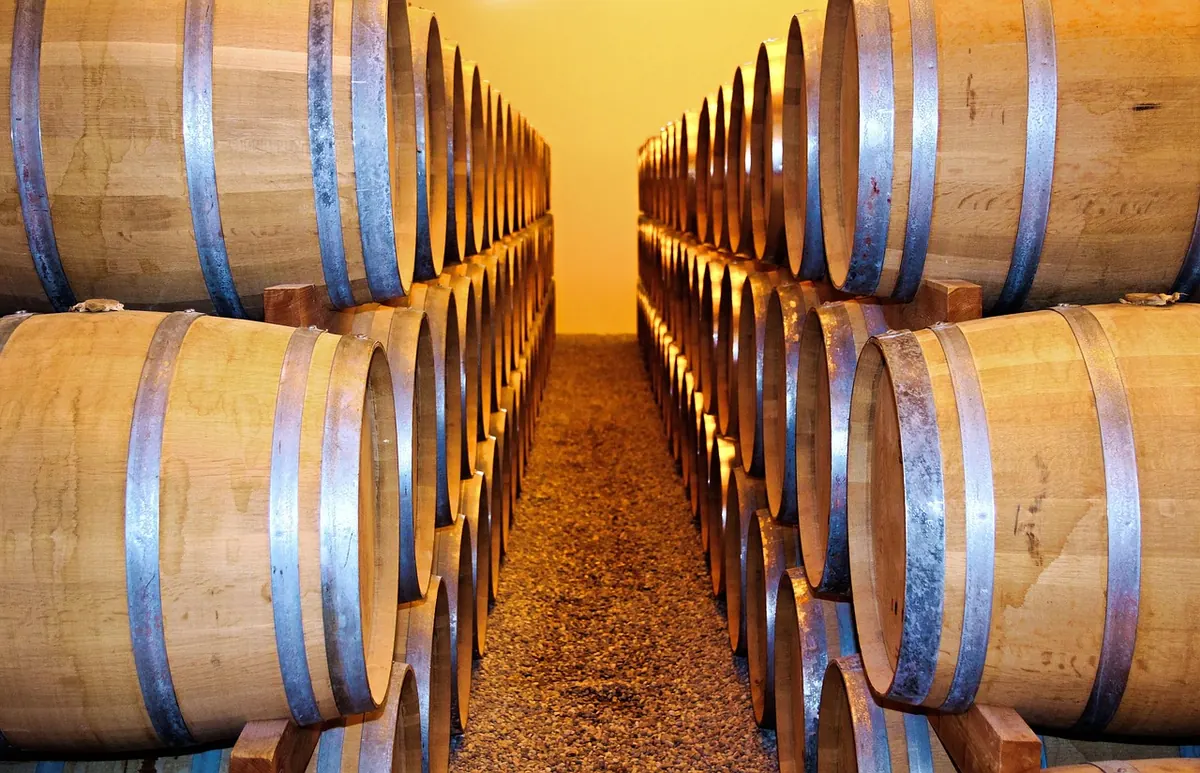
Barrels are where a tour earns its keep, because each one carries a small label of its own history. Look at the head of a cask — the flat circular end — and you will often find the cooper's brand, the year, and sometimes the origin of the oak. French oak tends to give finer, more restrained structure; American oak gives sweeter, more overtly spicy notes. Neither is better. Both tell you what the winemaker is chasing.
Toast, grain, and reuse
Toasting is the charring applied inside the barrel. A light toast keeps fruit to the front; a heavier toast pushes smoke, coffee, and spice. Grain matters too: tight grain releases flavour slowly, wide grain gives it up faster. Ask how many wines have passed through the barrel in front of you. A third-fill cask is a very different tool from a new one, and a cellar that tracks this properly is a cellar that thinks ahead.
The room around the wood
Now widen your view. Are the barrel stacks chocked and stable? Are the bungs clean and seated? Is there a hose coiled neatly rather than left in a puddle? Look for the small marks of routine: a topping-up schedule on the wall, sulphur wicks stored safely, a racking log. Stainless tanks nearby will have their own story — ask what's fermenting and what's just resting. A cellar that is tidy at 10 a.m. on a Tuesday is usually tidy at 3 a.m. during harvest, which is when it counts.
Bottles, Ullage, and the Library Shelf
In the bottle room, start at eye level on the oldest rack. Bottles should lie horizontally, with the wine touching the cork. Check the fill level — the gap between wine and cork is called ullage, and a noticeably low shoulder on a young bottle is a warning sign. Dust should be even and soft; a clean patch on one bottle often means a leak was wiped up.
Labels reward a slow look. Stained or peeling labels suggest past damp, and a mouldy capsule is worth a question rather than a panic. If there's a library section — older vintages held back for the estate — ask how those bottles are checked and how often. Anyone can stack old wine. Keeping it alive takes attention.
The Ten-Point Checklist
- Door and threshold: sealed, insulated, no draughts or warm patches.
- Thermometer placement: away from doors, and a record you can ask to see.
- Gradient: cool air pooling low, no sudden warm pockets.
- Smell: wet stone and clean wood; no vinegar or mustiness.
- Damp: brick bloom fine, standing water and barrel-head mould not.
- Light: minimal daylight, no bare tubes pointed at bottles.
- Barrel heads: readable coopers' marks, clean bungs, stable stacks.
- Records: topping-up, racking, and fill history kept somewhere visible.
- Bottle fill levels: ullage consistent across a case.
- Hygiene: hoses, drains, and floors treated as if the wine can taste them.
Questions Worth Asking Your Guide
Guides relax when someone asks something real. Skip "what's your best wine" and try these instead.
- What's the hardest month of the year for this room, and why?
- Which barrels here will be reused, and what goes into that decision?
- How do you decide when a wine comes out of barrel?
- What changed in the cellar in the last five years?
- What do you do when a bottle or a barrel goes wrong?
The last question is the most revealing. Every cellar has failures. The answer shows whether they are studied or hidden.
Before You Climb the Stairs
Take thirty seconds at the exit to write down three things: one detail you noticed, one question you didn't get answered, and one wine you now want to taste with that room in mind. If the tour ends with a tasting, compare the wine against what you just saw — a tight, reductive white from a cold cellar reads differently once you've stood in that cold.
And if you are building or rethinking a cellar of your own, treat the visit as research rather than entertainment. Photograph the racks, note the thermometer placement, ask what the owner regrets. The best tours are not the ones with the most stories. They are the ones that leave you able to look at any cellar — including your own — and see what is actually happening.
Photo: ReinhardThrainer / Pixabay